

Winemakers Cautious on Big-Ticket Purchases
Economic forces and a smaller than expected harvest make wineries hesitant to invest in more equipment.
Winemakers appear less willing to make a significant capital expense investment this year as opposed to last year, but many will be spending the same as the industry continues to find a new equilibrium following the pandemic.
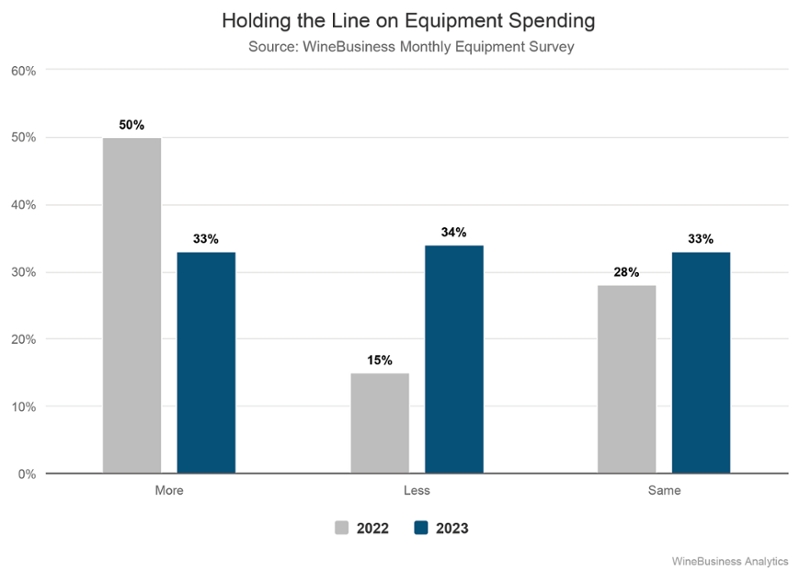
According to the 2023 WineBusiness Monthly Equipment Survey, one-third of those surveyed plan to spend more on winemaking equipment, and another third plan to spend the same; the remainder will spend less on equipment. In 2022, slightly more than 50% of those surveyed reported they spent more on capital expenditures that year than in the previous one.
Citing the ongoing market disruptions of the pandemic, as well as reduced production due to wildfires, many winemakers and winery owners had decided to hold off on making any significant upgrades since 2020.
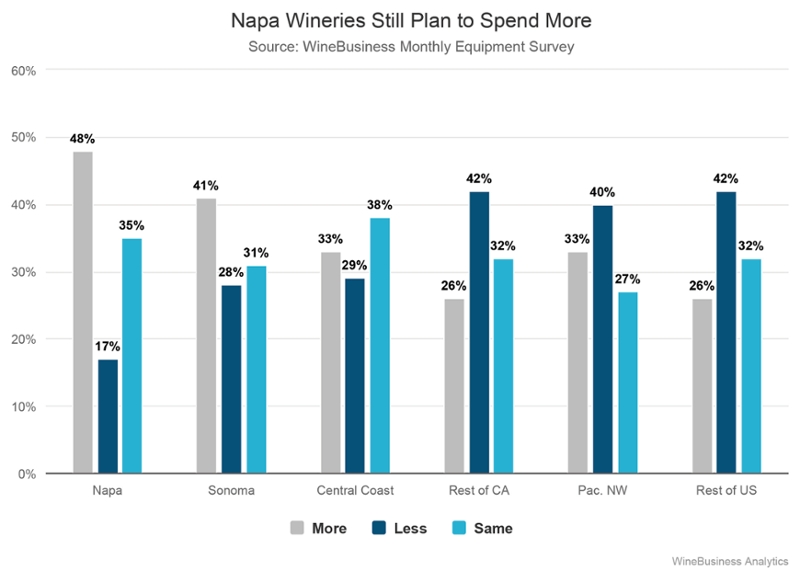
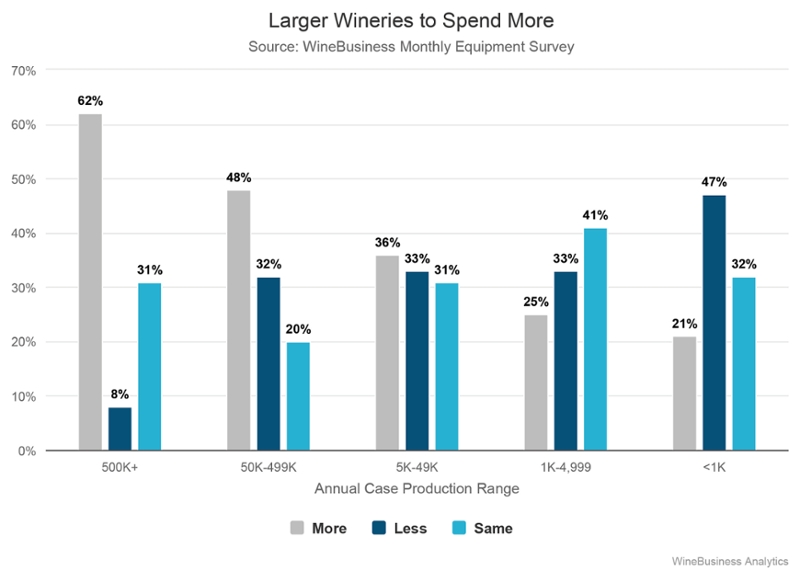
In Napa County, however, nearly half of those surveyed, or 48% (compared to 65% last year), said they would be spending more this year, and 62% of those at large wineries (producing more than 500,000 cases a year) also plan to spend more. In Sonoma County, those planning to spend more accounted for the largest share of those surveyed, 41%, compared to 52% last year.
On the Central Coast, the highest share of those surveyed, 38%, planned to spend the same, which is up from 13% last year, and 42% of those across the rest of California would be spending less compared to 14% last year. The largest share of those surveyed in the Pacific Northwest (40%) reported they would be spending less this year compared to 13% last year when 50% of those surveyed planned to spend more. Across the rest of the United States, 42% said they would be spending less this year compared to 19% last year.
Among limited production wineries that produce fewer than 1,000 cases, 47% said they would be spending less while one-third of wineries that produce between 1,000 and 5,000 cases also expected to spend less on equipment this year.
When asked how much less they would be spending on equipment this year, the average among all responses was 52%, with those in Napa reporting 58% and Sonoma averaging slightly more than 60%. On the Central Coast, most planned to spend nearly 33% less, with winemakers in the rest of California expecting it would be 50%. Those in the Pacific Northwest reported 59%, and across the United States it was 50%.
By winery size, winemakers at operations that produce between 1,000 and 5,000 cases planned to spend 57% less on equipment while those producing between 5,000 and 50,000 planned to spend 54% less.
This year’s survey was focused, in part, on the crush pad and the cellar, and results showed little interest in investing in equipment to reduce labor needs and costs during grape receiving and processing. Among all those surveyed, 70% said they were not planning to invest in improving their crush pad, and that disinterest was highest among those at smaller wineries. More than 81% of those surveyed at wineries that produce fewer than 1,000 cases were planning to upgrade their crush pads. Interest in reducing labor and processing costs on the crush pad was highest in Sonoma County where 43% of those surveyed were considering improvements and 42% in the Central Coast.
Winemaking Insights
Considering the scant interest in improving crush pads, it’s no surprise there was a similar lack of interest in new destemmers, with just 21% of those surveyed saying they were interested in buying a new one. Of those that were in the market for a new destemmer, 44% stated it was to improve wine quality, and 33% said it was to improve crush pad efficiency.
In terms of how crush pads are set up, nearly 46% of those surveyed who produce red wine use a must pump and hose to transfer processed red grapes to fermenters. The next most common set up (24%) is to use a forklift and bin dumper to directly drop grapes into open-top tanks. Another common set up—described by those who selected “other” in the survey—is to feed sorted and processed grapes onto an elevated conveyor that then dumps directly into tanks.
Sonoma County wineries were the exception in that the forklift and bin dumper method was as popular (39%) as the must pump and hose. Larger wineries were unique for the largest share of wineries, reporting they use a must pump and fixed lines to transfer processed grapes.
For white grapes, the majority, or 66% of those surveyed, do not cluster sort white grapes, and 54% of all wineries use a forklift and bin dumper to drop clusters directly into the press. While 37% of wineries not on the West Coast do use a forklift and bin dumper for white grapes, 42% elect to use a must pump.
Among wineries that use must pumps to move processed red grapes, there is no single type that appears to be most popular, with peristaltic, progressive cavity and screw pumps all being used by nearly 15% of the wineries that utilize must pumps. In Napa and Sonoma counties, progressive cavity pumps were used by 26% of participating wineries, yet an equal share of wineries in these counties reported they did not use a must pump.
The largest wineries exhibited high use of progressive cavity and lobe pumps, with each accounting for 27%, while wineries that produce between 50,000 and 500,000 cases had a higher rate of using screw pumps (36%). Smaller wineries employed a greater variety of must pumps or didn’t have one at all, with 46% of wineries that make between 1,000 and 5,000 cases without a must pump.
Those processed red grapes are most likely headed to an open-top stainless steel tank as that was the preferred fermentation vessel for 58% of those surveyed. Half-ton Macrobins were the second most popular option at 53% followed by closed-top stainless steel at 46%. Closed-top tanks were the most popular fermentation vessel in Napa County with 84% of those surveyed, and nearly all the largest wineries (90%) and 80% of wineries that produce between 50,000 and 500,000 cases.
Sonoma County and the Pacific Northwest are fans of open-top stainless-steel tanks, with 70% of those surveyed in Sonoma saying they use the tanks for red wine fermentation and 73% in the Pacific Northwest. The bins are very popular for fermentation among wineries that produce fewer than 5,000 cases. Barrels and puncheons were used for red fermentation by 21% of all survey participants, but this share increased to 47% among Napa wineries.
The overwhelmingly popular pick for white wine fermentation is stainless steel tanks with 83% of all participants followed by 54% who picked barrels and/or puncheons. The use of barrels for white wine fermentation was higher in Napa (83%) and Sonoma (88%). Vintners in the Northwest demonstrated equal support for both stainless steel (80%) and barrels (71%).
In terms of removing pomace, manual dig outs from both inside and outside tanks are the most common method with more than 70% of all survey participants. Given the popularity of small bins for fermentation, tipping out with a forklift was also popular, especially with smaller wineries, with 19% of those producing between 1,000 to 5,000 cases. Among the “other” options for emptying red wine fermenters was sluicing or using a hose and pump to push any pomace out of the bottom drain valve into a bin or to a press.
While 72% of all wineries surveyed have some time of tank monitoring system with temperature control (including 67% among wineries in the “rest of the U.S.”), this is nearly flipped for the ability to conduct remote winemaking work. Only 15% of all wineries reported they could perform some winemaking work (like start a pump-over) remotely. The highest rate with this functionality was for wineries in Napa County where 45% reported they can perform some tasks remotely, and among the largest wineries, 50% said they could do so.
The use of winemaking software was much more prevalent: 49% of all wineries reported they use a winemaking software program, ranging from 63% in the Central Coast to 84% in Sonoma County. In the Pacific Northwest, 47% of wineries use winemaking software, but only 35% of wineries across the rest of the United States do so. The use of such software also falls in relation to the amount of wine produced, with nearly all large wineries using a winemaking program to just 19% for limited production wineries. While many wineries report they have not adopted such software because of the cost, nearly 50% of all wineries don’t see the need for winemaking software, with that share increasing to nearly 60% among small wineries.
Despite cost pressure from inflation and disruptions to an already tight labor pool, this year’s survey did not find much interest for automating winemaking operations. Slightly more than 70% of those surveyed are not planning to further automate cellar operations. It was only among those wineries that produce more than 500,000 cases where a majority (80%) are looking to automate further, but that share declined to just 40% of those working at wineries that produce 50,000 to 499,999 cases a year. Sonoma County wineries did show a bit more interest than other regions, with 46% of those surveyed from that area interested in further automation.
Of the roughly 30% of those surveyed who are interested in more automation, 42% want to install a central winemaking control system, and 36% would like to add fixed pump-over pumps and irrigator lines to their fermentation tanks. In Napa and Sonoma counties, there’s more interest in an improved pump-over system while vintners in the Central Coast and the rest of California are equally interested in easier pump-overs and a central winemaking system. Among wineries not on the West Coast, 58% were interested in a central winemaking system while just 17% wanted to improve their pump-over setup.
Equipment Investment Strategies
Jeff Hinchliffe is the winemaker at Hanna Winery in Healdsburg, Calif. where he’s overseen a dramatic increase in the production of Russian River Valley Sauvignon Blanc. The winery makes around 60,000 cases of wine a year, and roughly 40,000 cases of that is Sauvignon Blanc.
In addition to Sauvignon Blanc, the winery also makes popular Bordeaux varieties, some Italian reds and wine from the lesser-known Bordeaux variety Saint-Macaire. Hinchliffe said Hanna may well be the only winery in California that produces Saint-Macaire. The winery has one half-acre planted to the grape and another half-acre sowed this year. Hanna is also planting a small Grillo vineyard and already produces Nero d’Avola, Colombard and Sangiovese.
With a large-volume production program and a smaller one centered around lesser-known varieties, Hinchliffe manages and works with two different sets of equipment. For the Sauvignon Blanc and mainstay Bordeaux grapes, like Cabernet Sauvignon, he uses larger volume equipment and just recently purchased a new EuroMachines 120HL press and an elevated conveyor to feed it.
“I have a long experience with that company and their equipment and tanks are just great,” he noted. “We bought our first EuroMachines press in ’98, and it’s still going strong. It’s simple, efficient and durable.”
That new equipment, and other upgrades, has ensured the winery keeps pace with the demand for its Sauvignon Blanc, but Hinchliffe said he uses custom pressing services when needed. Hinchliffe explained that the existing winery footprint and tighter wastewater rules limit the company’s ability to grow at its existing location, so he will likely have to move more of the large production programs off-site. He said the larger programs can use custom crush if needed, especially the Sauvignon Blanc.
For the other wines, which are sold primarily direct-to-consumer (DTC), Hinchliffe said he has rented an optical sorter in the past and may do so again as the smaller lots are all hand-sorted. He may invest in a few additional smaller volume tanks to handle the increase in estate production, as well as to give him and his team plenty of flexibility when it comes to fermentation.
“You can never have enough small tanks,” he said.
After fermentation is done, Hinchliffe works with a couple of firms for mobile filtration and uses Ultima Mobile Bottling for the final product. “We’ve looked at the ROI on this equipment and the staffing required, and even at 60,000 cases, it still doesn’t pencil out to purchase it,” he said.
That calculus is critical for smaller wineries that are looking to expand and is one even the most experienced vintners must make nearly every harvest.
Rickey Trombetta was a home winemaker who then went on to work with Paul Hobbs as he was getting established in Sonoma County, and Hobbs, in turn, helped inspire Trombetta’s daughter, Erica Stancliff, to become a winemaker. Stancliff and her mother now run Trombetta Family Wines, which produces around 1,200 cases of Pinot Noir, Chardonnay and Rosé from Gap’s Crown and other vineyards in Sonoma County.
According to Trombetta, prior to the pandemic, she and her daughter had considered buying a small winery for their growing brand, but just running the numbers on the overhead to equip and staff an estate facility proved to be too daunting.
“For small production wineries, honestly, you have to have a lot of money behind you to even consider going through the process of building a winery these days,” she said, noting all the additional costs, from permitting and environmental reviews in addition to just construction.
While a small volume operation, Trombetta’s wines are distributed throughout California and to accounts in Las Vegas, Kansas City, Maryland, Washington, D.C., and Virginia, plus, she just secured new placements in Tennessee, Alabama, and Canada this year. Those sales are matched 50-50 by DTC. The wine is made at custom crush winery, Punchdown Cellars, in Santa Rosa, Calif.
For wine companies similar in size to hers, Trombetta stressed that working with a custom crush provider that is able, and willing, to grow with the brand is vital.
“That’s the beauty of it: they have the ability to provide the equipment, as long as we give them enough time,” she said. “The nice part is, I don’t have to worry about getting forklifts repaired.”
Rather than having an estate winery, Trombetta said that increasing her brand’s production would likely support a tasting room, most likely in a facility shared by a few other small wineries. She estimated that she would need to be making closer to 3,000 cases a year for that type of expansion to happen.
It’s much more expensive to scale up a winery in the North Coast of California than in other parts of the United States, yet wineries in emerging wine regions still need to be judicious and strategic while investing in new equipment.
Michigan’s 12 Corners Vineyards in the southwest corner of the state lies near the shores of Lake Michigan. The winery, located in Benton Harbor, produces around 6,000 cases a year; and since its opening in 2012, winemaker Glen Greiffendorf has almost always needed a little bit more capacity. “The pumps and press still get the job done, but we always need tank space,” he said.
The winery opened with 25 small capacity tanks, but a diverse lineup of dry, semi-sweet, fruit and dessert wines, as well as hard cider and non-alcohol wine, is a bit of a logistical challenge during harvest. The lineup expanded further this year with the addition of a sweet sparkling wine and a dry Rosé.
While the pandemic slowed things down for 12 Corners, the winery is always developing something new for its customers in the tasting room, reported Greiffendorf.
The sparkling wines are produced with a neighboring winery that has a Charmat tank, but Greiffendorf said the winery may invest in a semi-auto sparkling wine corker and wire hood unit.
Another sparkling producer, but in the northwest corner of Michigan on the Leelanau Peninsula, Mawby Vineyards & Winery provides custom crush services to support its equipment investments and production growth.
Operations manager and winery partner Peter Laing stated that equipment investments are based on a five-year sales plan.
In an email, he explained that if they need additional capacity or equipment to get them there, they look at the most inefficient operations first, as well as any aspect of their production flow that they could change to improve quality.
“We always look at payback and utilization when we are looking at new equipment,” he said.
Another key consideration in any investment or increase in production is whether custom services can help cover the cost of either. “As one of the only producers—and the only sole producer—of sparkling wine in our area, we are often contacted when other wineries want to add a sparkling wine to their portfolio,” Laing wrote.
The winery was founded by Larry Mawby who began producing some Méthode Champenoise wines in the 1980s and then focused on just sparkling wine in the late ‘90s. Mawby added Charmat production in the early 2000s to offer a lower cost option for custom crush clients and to be able to respond quickly to opportunities in the market.
Laing added that the company did just invest in a used tirage bottling line with a filler, biduler and crowner. The used equipment was complemented by a new semi-automatic disgorger and wire-hooder. These machines will take over work that had been done by hand for the past three decades.
“This will improve consistency and efficiency on our Méthode Champenoise wines going forward,” he said.
Another process that has been somewhat automated recently at the winery is case packing. “Because we don’t currently have a way to warm and dry bottles after disgorging or counter-pressure bottling, we have to let the bottles air-dry and then re-handle them to label and case,” Laing noted. “We recently made some investments in case sealing and printing equipment to make that more efficient.”
That included buying an Eastey case taper, Squid Ink printer for case printing and a conveyor to feed the printer from Packline.
Rick Mafit, founder and winemaker at Mystic Wines in Amity, Ore., understands the equipment question from the perspective of both the buyer and seller. After starting his career in California, Mafit moved north in 1990 to launch his own brand and also took a job as the Northwest technical sales manager for winemaking materials and equipment vendor Scott Labs in Petaluma, Calif.
“I always knew my own winery was something I wanted to do, but I didn’t have anyone to back me,” he recalled. “It was also an opportunity to learn a side of the business I didn’t know which was selling.”
After 33 years, Mafit has recently retired from his sales job after watching and supporting the dramatic growth of wineries in Oregon and elsewhere in the Pacific Northwest. As a winemaker, Mafit worked his 45th harvest this year and said for wineries that only produce a couple thousand cases, like himself, investing in a few key pieces of equipment for receiving and processing grapes is most likely sufficient. While he understands the temptation, he cautioned that winemakers shouldn’t be dazzled by the latest technology or lose sight of the most vital operations in winemaking.
“A winery is like a house: it always needs new sliding windows or doors, so there’s always somewhere to spend money on something,” he said.
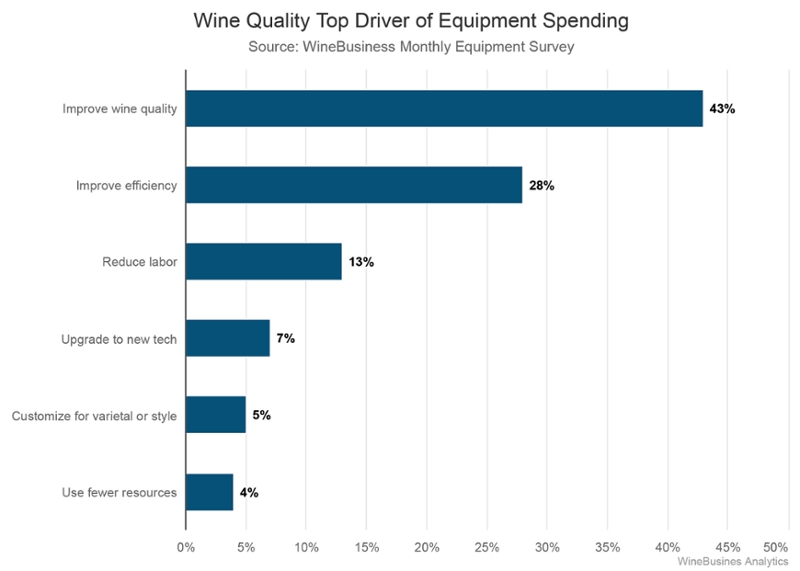
When working with larger wineries, Mafit stated that the biggest driver in equipment investments is to reduce labor. An optical sorter starts to make a lot more sense when it means being able to significantly reduce how many workers are needed for harvest.
Yet as production increases, efficiency and logistics become much more important factors in equipment strategy. The crush pad throughput rate is much less important to the winery that handles three or four bins a day than a winery that receives 100. A harvest schedule—from pick dates to allocating tank space—depends on being able to know for sure how long it will take to process a certain number of tons. These types of calculations also assume vital equipment, like destemmers, won’t break down.
“When you’re doing 50 or 40 tons, like us, in a harvest, our biggest worry is what we’re having for dinner when we’re done,” Mafit explained. “For bigger wineries sometimes, you don’t have to have a Cadillac when a Toyota will be as good and dependable.”
